water research
- Home
- Topic
water research
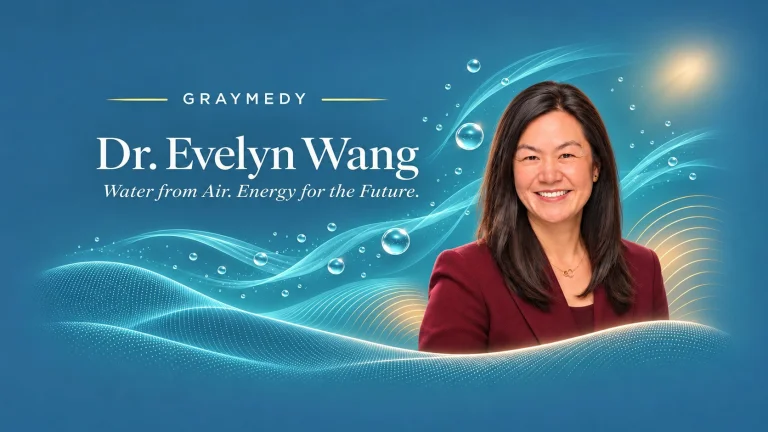
Dr. Evelyn Wang studies a resource that most people cannot see: the moisture in the air around them. As a mechanical engineer at the Massachusetts Institute of Technology, she has worked with collaborators on devices that draw water from air, including in dry environments where access to fresh water can be difficult. Her research connects water with another everyday challenge: how to move and use heat more effectively. From cooling and energy storage to water harvesting, Wang's work applies heat and mass transfer to practical problems. A path from engineering to research Wang earned her undergraduate degree in mechanical engineering at MIT and completed her master's degree and doctorate at Stanford University. After postdoctoral research at Bell Laboratories, she joined the MIT faculty in 2007. Her connection to MIT is also personal. Her parents met there as graduate students, and Wang later met her husband at the Institute. She went on to lead MIT's Department of Mechanical Engineering from 2018 to 2022, while building a research programme in energy and water technologies. Today, Wang is the Ford Professor of Engineering and MIT's Vice President for Energy and Climate. She previously directed the United States Department of Energy's Advanced Research Projects Agency-Energy from 2023 to 2025, supporting early-stage energy research and development. Finding water in dry air In 2017, Wang and colleagues at MIT and the University of California, Berkeley reported a device designed to harvest atmospheric water using heat. It used a porous material called a metal-organic framework, developed by Berkeley chemist Omar Yaghi and his team, to capture water vapour. Heat helped release the captured moisture, which could then condense on a cooler surface. In 2018, the team reported field tests of a small device in Arizona. The researchers demonstrated water collection in desert conditions using sunlight. The test was a proof of concept, producing small amounts of water; its projected output at larger scale was not a measurement from a household-sized system. Later work investigated a two-stage design that reused heat to improve water production. These studies show how a device can progress from an idea to experiments and field testing, while still requiring further work before wider use. Why heat matters Moving heat is part of producing water, cooling equipment and making energy useful. Wang's research examines these processes at small scales and uses materials and device design to improve how systems perform. Her work includes thermal management, energy conversion and storage, desalination and water conservation. Although the applications differ, each asks how a system can make better use of available heat or manage it more effectively. Research areaQuestion being exploredWater harvestingHow can moisture in the air be captured and collected?Thermal managementHow can heat be moved or controlled more effectively?Energy conversion and storageHow can energy be captured, stored and used more efficiently?Water purificationHow can engineering improve access to usable water? From research to real-world use A promising laboratory result is only one step towards a practical system. Water output depends on local conditions and device design, while materials, cost, maintenance and water quality also matter. A field test can establish that an approach works under particular conditions, but it does not establish that every community can use it at scale. Wang has also spoken about the role of partnerships in moving climate and energy research forward. Universities, industry, government and communities can each contribute to the work of testing, adapting and putting new ideas into use. For Wang, the opportunity is to connect fundamental engineering with problems people encounter every day. Her work on water and heat shows how research into processes that often go unnoticed can open new possibilities for communities and future technologies. Editorial note: This independent profile is based on public sources. Graymedy did not interview Dr. Wang for this article. Sources: MIT faculty profile; MIT News: Evelyn Wang; MIT News: water from air; MIT News: desert field test; MIT News: two-stage system. Watch: Evelyn Wang on energy and water technologies In this research talk, Wang discusses energy and water technologies and the materials used to develop them. Watch the full talk on YouTube.